40 seconds · every figure measured from the source trees
The story, in four turns
I46,190
Upstream never stops
The FreeBSD Ports Collection carried 46,190 commits in the past
year — 126 a day, across 34,779 ports. It is one of the largest
software catalogues in the world, and it moves every single day.
II5,029
Not every change survives the trip
DragonFly BSD is not FreeBSD. Keeping the catalogue building means
carrying 5,029 explicit overlays — the exact places where the two
systems differ — maintained until now by hand,
by a handful of people, against seven hundred upstream committers.
III0
Ships without a human decision
Polytropos composes the trees, builds the result, and repairs what
breaks. Agents triage failures, write patches, and verify them with
green rebuilds. Every fix arrives as a proposal with its proof
attached — and an operator approves what ships. Nothing lands on
its own.
IV126/day
The pace it has to keep
Upstream moves 126 times a day, and the answer is a steady
stream of fixes instead of heroic catch-up: DragonFly users get
the software FreeBSD users have, at the versions they have it,
without thinking about it.
Homer’s first word for Odysseus —
the man of many turns, resourceful when the way is blocked.
The operations console
Agents propose. You approve.
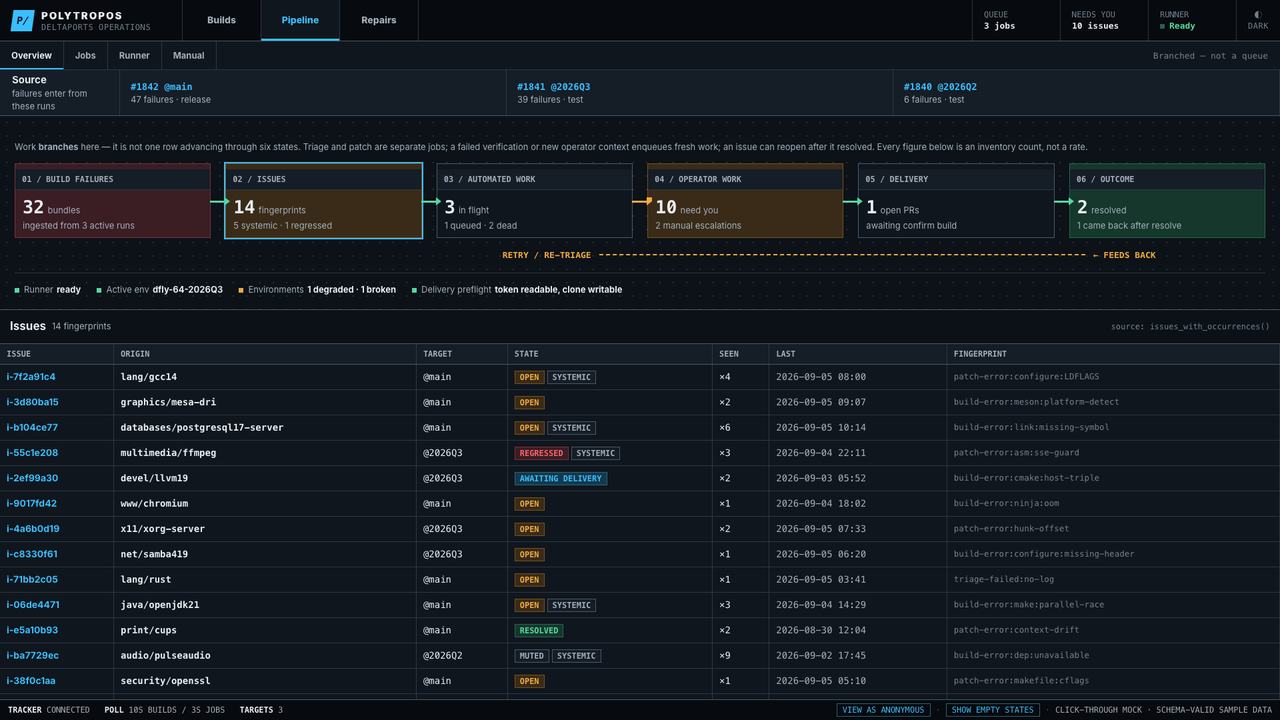
One surface shows the whole
pipeline — from build failures through triage to delivery — and every
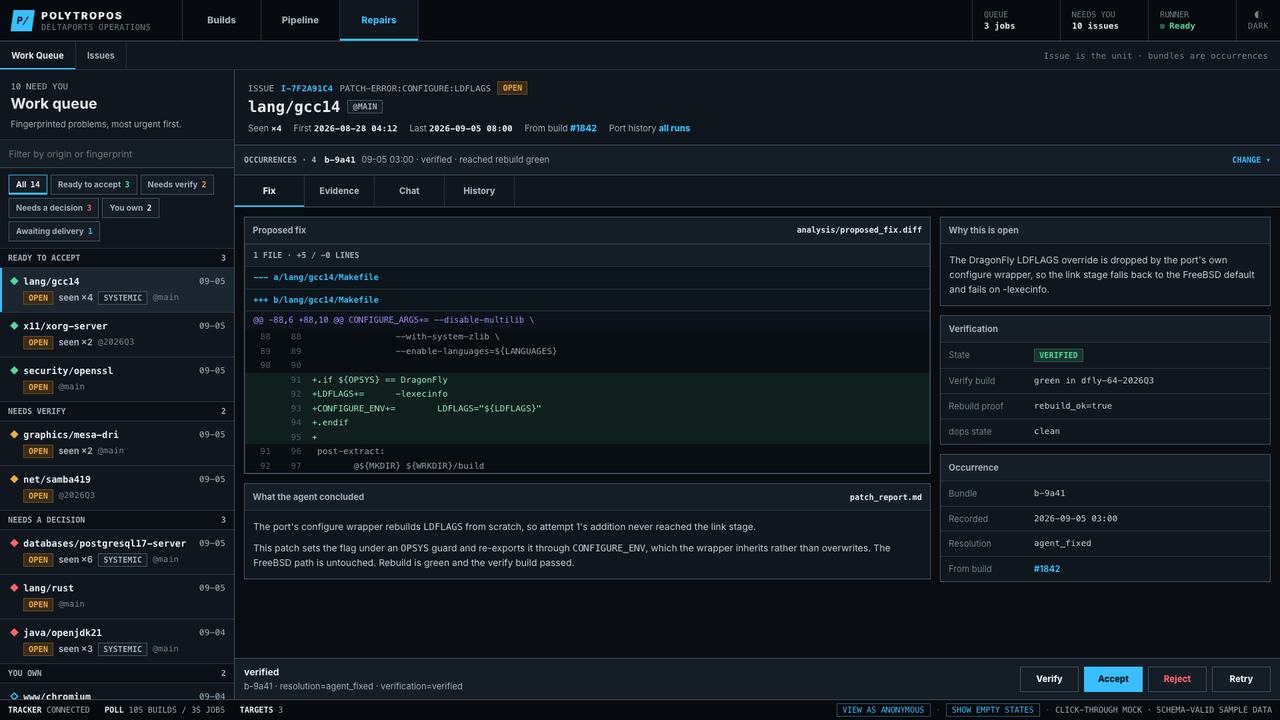
repair arrives with its diff, its reasoning, and its rebuild proof.
The pipeline. Failures flow from build runs through
agent triage and repair toward delivery — and the queue that needs a
human is always one glance away.The repair. The proposed patch, what the agent
concluded, and the verification record — state, rebuild proof, green
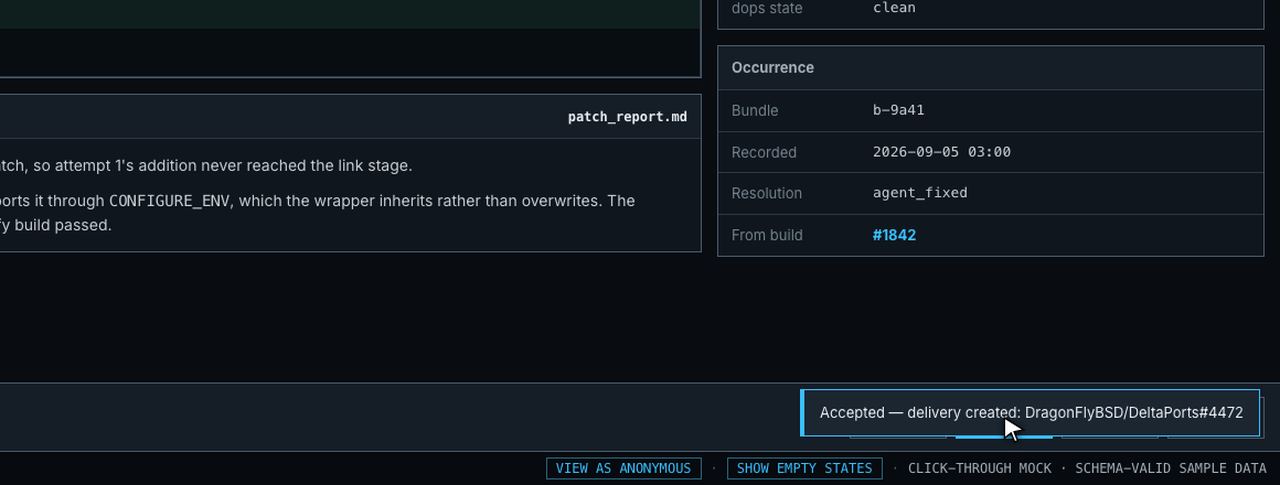
verify build — on one page.The decision. Verify, Accept, or Reject. One click,
and the delivery opens downstream. Interface
shown with schema-valid sample data.
Run it yourself
The demo needs no chroot
The
repository ships a local demo that drives the real tracker — real
reconcile loop, real state machine, real UI — with only the DragonFly
build itself substituted. The suite ships green: 2,085 tests.
# install
git clone https://github.com/DragonFlyBSD/polytropos
cd polytropos
uv venv .venv && uv pip install --python .venv -e ".[tracker,agent,dev]"

# seed the demo and open the tracker
.venv/bin/python demo/seed_demo.py --db /tmp/dports-demo/state.db
.venv/bin/python -m dportsv3 tracker serve --db /tmp/dports-demo/state.db --port 8899
Full
operator setup, the three input trees, and the design records live in
the repository’s
docs/.